

From Digital Skills to Interactive Simulations
Why Kwathu Is Building Games
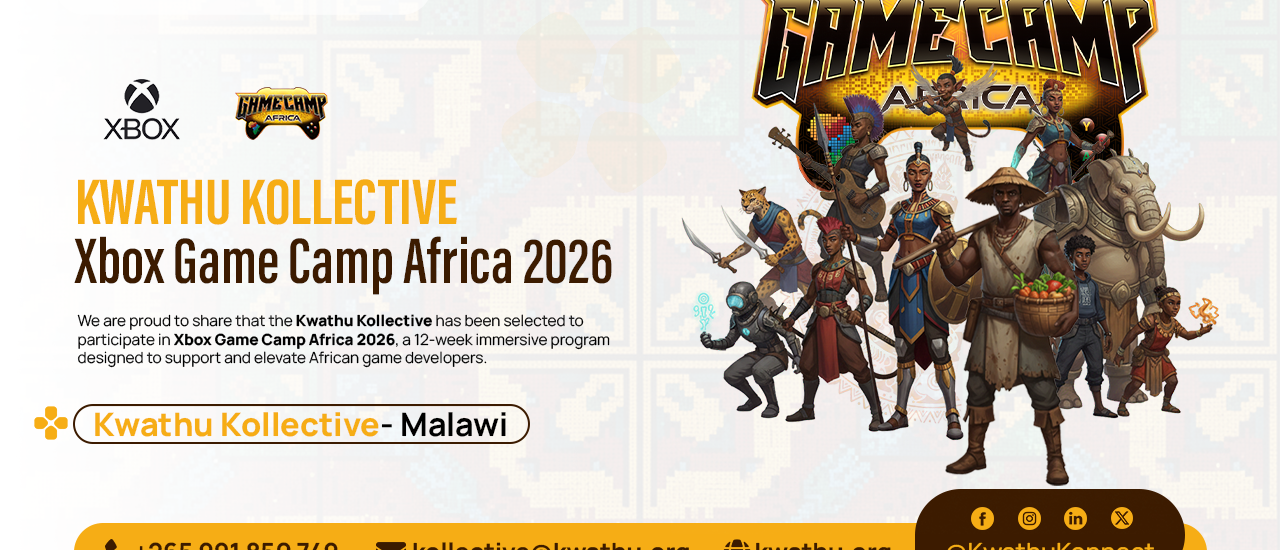
We are proud to share that Kwathu Kollective has been selected to participate in Xbox Game Camp Africa, joining a cohort of 18 studios from 12 African countries in a highly competitive, continent-wide program.
This moment is less of a pivot for us, and more of a very intentional continuation.
At Kwathu, gaming has always been central to our work— as out foundational digitial skills courses were gamification courses.
Game development is the next logical layer in a journey that began with digital skills, expanded into media and systems thinking, and has now arrived at interactive simulation as a tool for knowledge creation, learning, and economic participation.
Where We Started: Digital Skills as the Foundation
Kwathu’s work began with a simple but urgent question: how do young people in Africa access, use, and shape the digital tools that increasingly define opportunity?
That question led to the creation of Digital Skills for Africa (DSA)—a Kwathu platform designed to build foundational digital capacity across the continent. Through DSA, we focused on practical, applied skills such as digital literacy, media creation, web development, cybersecurity basics, and digital marketing—delivered in ways that were accessible, low-data, and grounded in local realities.
The goal was never skills for skills’ sake. It was about agency—enabling people to participate meaningfully in a digital economy rather than remaining passive consumers of it.
What this work revealed to us over time was critical:
Skills alone are not enough. Without context, systems, and real-world application, knowledge remains abstract.
From Skills to Creation: Media, Storytelling, and Production
As digital fluency grew, the natural next step was creation.
Kwathu expanded into media production, storytelling, and content platforms—supporting creators to move beyond consumption into authorship. We saw firsthand how narratives, visuals, and cultural context shape engagement, learning, and identity. We also saw the limits of static formats.
Linear content—articles, videos, even courses—can inform.
But they rarely allow people to experiment, decide, or see consequences.
This insight marked an important shift in our thinking: the future of learning would not be purely informational. It would be experiential.
The Systems Turn: IoT, AgTech, and Real-World Modeling
Our work then extended into IoT, AgTech, and smart systems, particularly in agriculture and community-based innovation. Here, the lesson became unavoidable: real-world challenges are not isolated problems—they are systems.
Farming, for example, is not just about crops. It is about water, timing, inputs, climate, labour, economics, and collective decision-making. These dynamics are difficult to teach through lectures or manuals because they are non-linear and interdependent.
What was missing was a medium that could hold complexity without oversimplifying it.
Why Interactive Media—and Gaming—Became Inevitable
That medium is games.
Games are not simply entertainment. At their best, they are living systems—interactive environments where players learn by making decisions, observing outcomes, adapting strategies, and understanding trade-offs over time.
Unlike traditional media, games allow:
- Exploration instead of instruction
- Systems instead of scripts
- Learning through consequence, not memorization
For Kwathu, gaming became the natural convergence point where digital skills, media creation, and systems thinking meet.
The Economic Case for Gaming
Globally, gaming is one of the largest and fastest-growing creative industries, with revenues surpassing film and music combined. Yet Africa—despite its youthful population and mobile-first engagement—remains underrepresented as an owner of gaming intellectual property.
This gap represents both a challenge and an opportunity.
Gaming is not just about play; it is about:
- Exportable intellectual property
- Jobs across art, code, narrative, and design
- Participation in a global creative economy
Entering this space early matters. Ecosystems reward first movers who build capability, credibility, and original IP before markets mature.
AI as the Catalyst, Not the Driver
AI has accelerated this moment.
Tools such as Project Genie and other generative platforms are lowering barriers to prototyping, world-building, and simulation design. This does not replace creativity or judgment—it shifts the value equation.
As AI democratizes execution, systems thinking, storytelling, and context become the differentiators.
For us, AI is not the reason to build games. It is the enabler that makes this work more accessible, scalable, and timely.
Xbox Game Camp Africa: Validation and Access
Being selected for Xbox Game Camp Africa is an important validation of this long arc of work.
This year’s cohort brings together 18 studios from 12 African countries, selected from a highly competitive pool. Importantly, participating teams retain ownership of their intellectual property while gaining mentorship, industry exposure, and access to global networks.
For Kwathu—and for Malawi—this represents entry into a global conversation about who builds games, whose stories are told, and who benefits economically from interactive media.
Introducing Kwathu Farms
Out of this journey emerges Kwathu Farms—a simulation game that brings together agriculture, community, and economics as an interactive system.
Set initially in Malawi but designed for a global audience, Kwathu Farms invites players into a living environment where decisions about land, technology, collaboration, and resources unfold over time. It is not a farming game in the narrow sense; it is a systems simulation that reflects real trade-offs and consequences.
At its core is a simple question:
“This is your land. Can you make it thrive?”
What Comes Next
In the months ahead, Kwathu will participate in Xbox Game Camp Africa while advancing prototypes and demos of Kwathu Farms. Longer term, we see interactive media becoming a core pillar of our work—alongside digital skills, media, and systems innovation.
This is not about replacing education or traditional development models. It is about augmenting how knowledge is created, tested, and shared in a world defined by complexity.
Kwathu’s bet on gaming is a bet on interactive futures—where learning is experiential, economies are participatory, and people are equipped not just to understand systems, but to shape them.
Stay with us as we build.
Work With Us
Want to partner on or fund one of our programmes / initiatives? We are always open to collaborations and partnerships. Contact us via kollective@kwathu.org, or give us a call(direct or WhatsApp) on +265991850749.
To keep up with the work of the Kwathu Kollective, our initiatives and our projects, follow us on socia media:
KWATHU KOLLECTIVE SOCIAL MEDIA


