

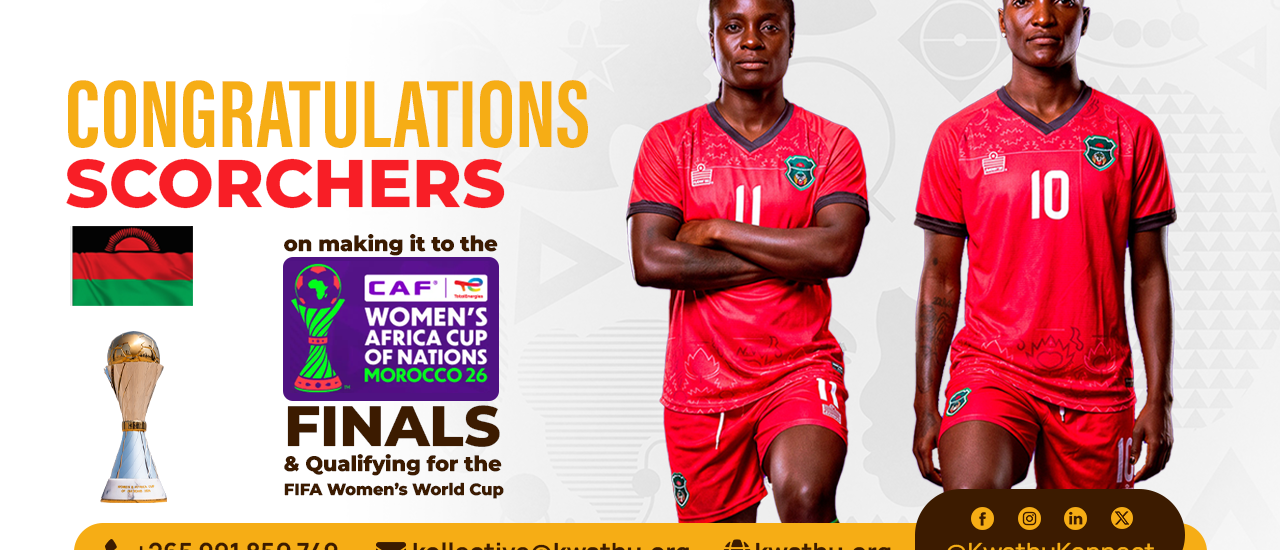
From 153rd to the WAFCON Final: The Scorchers’ Journey into History
Curated by Nthanda Manduwi
Founder, Kwathu Kollective
Malawi arrived in Morocco ranked 153rd in the world, playing at the Women’s Africa Cup of Nations for the first time in history. Five matches later, the Scorchers are FIFA Women’s World Cup-bound and one match away from becoming champions of Africa.
Kwathu Kollective joins Malawians at home and across the world in congratulating the Malawi Women’s National Football Team — the Scorchers — on an extraordinary run at the 2026 CAF Women’s Africa Cup of Nations.
There are sporting achievements that improve a country’s record.
And then there are sporting achievements that change what a country believes is possible.
This is the latter.
When the most recent FIFA women’s rankings were published on 16 June 2026, Malawi sat 153rd in the world. The Scorchers had never qualified for WAFCON. They had never qualified for a senior FIFA World Cup. They arrived in Morocco as tournament debutants, drawn into a group containing defending champions Nigeria and regional rivals Zambia.
Five games later, Malawi have beaten Nigeria, Egypt, Ghana and Algeria; qualified for the 2027 FIFA Women’s World Cup in Brazil; and reached the WAFCON final in their first appearance.
The ranking table has simply not had time to catch up with the history.
This journey did not begin in Morocco
The Scorchers’ rise has been years in the making.
Malawi’s women first entered senior international football in the early 2000s, but for much of the programme’s existence the country operated outside Africa’s elite women’s football structures. The transformation became much more visible in 2023, when Malawi produced one of the finest tournament runs in its history at the COSAFA Women’s Championship.
The Scorchers won all five matches.
They beat hosts South Africa 4–3, demolished Eswatini 8–0, defeated Madagascar 3–1, overcame Mozambique 2–1 in the semi-final and then beat defending champions Zambia 2–1 in the final to lift Malawi’s first COSAFA Women’s Championship title.
Temwa Chaŵinga finished that tournament with nine goals, winning both the Golden Boot and Player of the Tournament.
But the decisive doorway to WAFCON would eventually be opened by another generation.
After Congo withdrew from Malawi’s first qualifying tie, the Scorchers faced Angola for a place at Morocco 2026. The first leg finished goalless.
In the return leg, Malawi were still level after 80 minutes.
Then Faith Chinzimu scored twice in two minutes — in the 82nd and 83rd minutes.
Malawi won 2–0.
For the first time, the Scorchers were going to the Women’s Africa Cup of Nations.
That detail matters now.
The story of Malawi’s WAFCON tournament does not really begin with Temwa or Tabitha scoring against Nigeria.
It begins with a teenager making sure Malawi got there at all.
MATCH ONE
Nigeria 2–3 Malawi
Group C — 28 July 2026
Malawi could hardly have been handed a more intimidating first WAFCON match.
Nigeria entered the tournament as the defending champions and the most successful nation in the competition’s history, with ten continental titles. Malawi entered as first-time qualifiers.
For 72 minutes, the Scorchers held their own.
Then the tournament changed.
73′ — Temwa Chaŵinga: 1–0 Malawi
Temwa broke the deadlock and scored Malawi’s first-ever WAFCON goal.
79′ — Tabitha Chaŵinga: 2–0 Malawi
Six minutes later, the captain doubled the advantage.
Nigeria responded through a Rasheedat Ajibade penalty in second-half stoppage time.
Then, at 90+5:
Temwa Chaŵinga again.
Malawi led 3–1.
Nigeria’s Uchenna Kanu scored another deep into stoppage time, but there would be no escape for the defending champions.
Nigeria 2. Malawi 3.
The tournament debutants had beaten the champions.
The numbers
Malawi did not steal the game by hiding behind the ball.
Nigeria held only a modest possession advantage, approximately 54.7% to Malawi’s 45.3%. Both teams attempted 13 shots. Malawi put seven on target to Nigeria’s eight. Malawi actually won the corner count 5–4.
Mercy Sikelo made six saves.
Temwa alone attempted seven shots, put four on target and scored twice.
That first match established one of the themes that would define Malawi’s tournament: the Scorchers did not need to dominate possession to create elite attacking volume.
Malawi starting XI
Mercy Sikelo
Rose Alufandika — Chimwemwe Madise — Benadetta Mkandawire — Ireen Khumalo
Madyina Nguluwe — Letticia Chinyamula
Rose Kadzere — Faith Chinzimu — Tabitha Chaŵinga
Temwa Chaŵinga
Malawi began in a 4-2-3-1, with Temwa leading the attack and Tabitha operating as one of the primary attacking threats behind her.
Used from the bench
Sabinah Thom replaced Madyina Nguluwe in the 50th minute.
Vanessa Chikupila entered for Rose Kadzere in stoppage time.
One match into Malawi’s first WAFCON, the entire tournament had been put on notice.
MATCH TWO
Egypt 1–3 Malawi
Group C — 1 August 2026
Beating Nigeria could have been dismissed as one extraordinary afternoon.
Beating Egypt was how Malawi demonstrated that it was not.
This time the Scorchers controlled more of the football.
35′ — Rose Kadzere
Kadzere opened the scoring.
45+2′ — Faith Chinzimu
The teenager who had scored the two goals that qualified Malawi for WAFCON now had her first goal at the tournament itself.
Malawi went into half-time 2–0 ahead.
Then came adversity.
52′ — Rose Alufandika sent off
Malawi were reduced to ten players early in the second half.
What happened next may have been even more revealing than the goals that came before it.
Instead of retreating completely, the ten-player Scorchers scored again.
68′ — Temwa Chaŵinga: 3–0
Egypt pulled one back three minutes later through Eman Hassan, but Malawi closed the match out 3–1.
The numbers
Malawi had approximately 57.5% possession.
They outshot Egypt 22–15.
They put 10 shots on target to Egypt’s five.
And perhaps most strikingly, Malawi won 14 corners to Egypt’s one.
Those are not numbers associated with a team simply surviving a tournament.
They are numbers associated with a side imposing itself.
Kadzere was particularly influential beyond her goal, producing five key passes and three shots on target according to CAF’s statistical review.
Malawi starting XI
The Scorchers retained the same starting XI that had beaten Nigeria:
Mercy Sikelo
Rose Alufandika — Chimwemwe Madise — Benadetta Mkandawire — Ireen Khumalo
Madyina Nguluwe — Letticia Chinyamula
Rose Kadzere — Faith Chinzimu — Tabitha Chaŵinga
Temwa Chaŵinga
Used from the bench
Sabinah Thom replaced Letticia Chinyamula late in the match.
Tendai Sani, one of the three players added to the squad after the initial 23-player announcement, also entered late.
Two matches.
Six points.
Six goals.
Malawi were no longer merely enjoying a historic debut.
They were becoming a problem.
MATCH THREE
Malawi 1–2 Zambia
Group C — 5 August 2026
Every tournament run eventually asks a team how it responds when events stop going its way.
For Malawi, that match was Zambia.
The Scorchers were behind almost immediately.
2′ — Barbra Banda
The world-class Zambian striker gave the Copper Queens the lead before the match had properly settled.
37′ — Prisca Chilufya
Zambia doubled the advantage before half-time.
Malawi had lost Rose Alufandika to suspension following her red card against Egypt, forcing an adjustment in the defensive structure.
Still, the Scorchers fought their way back.
72′ — Tabitha Chaŵinga
The captain scored to make it 2–1 and give Malawi a route back into the match.
The equaliser never came.
But the scoreline hides something interesting.
The numbers
Malawi had approximately 45.2% possession to Zambia’s 54.8%.
Yet Malawi attempted 11 shots to Zambia’s 10.
More importantly, Malawi put five on target.
Zambia managed only three.
The Scorchers therefore lost a match in which they created more total attempts and substantially more shots on target than their opponents.
It was Malawi’s first defeat of the tournament, but it was not a collapse.
Malawi starting XI
Mercy Sikelo
Faith Chinzimu — Chimwemwe Madise — Benadetta Mkandawire — Ireen Khumalo
Madyina Nguluwe — Letticia Chinyamula — Sabinah Thom
Rose Kadzere
Tabitha Chaŵinga
Temwa Chaŵinga
Used from the bench
Asimenye Simwaka replaced Sabinah Thom.
Tendai Sani replaced Madyina Nguluwe.
Vitumbiko Mkandawire later replaced Sani.
At the end of the group stage, Malawi, Nigeria and Zambia all had six points.
The tournament’s head-to-head tiebreak process placed Malawi top of Group C.
For a country playing its first WAFCON, winning the group would already have been extraordinary.
But the next match would change Malawian football permanently.
MATCH FOUR
Malawi 2–1 Ghana
Quarter-Final — 9 August 2026
There is an additional layer to this result that makes it particularly remarkable.
Shortly before WAFCON, Ghana had beaten Malawi 4–0 in a pre-tournament friendly.
Less than three weeks later, the same countries met again.
This time there was a FIFA Women’s World Cup place on the line.
Ghana struck first.
7′ — Chantelle Boye-Hlorkah: Ghana 1–0
Five minutes later:
12′ — Temwa Chaŵinga: 1–1
Malawi did not allow the game to escape.
The second half became increasingly tense.
Ghana thought it had taken the lead again when Doris Boaduwaa found the net, but the goal was ruled out following a VAR intervention.
Then came the 79th minute.
Not Tabitha.
Not Temwa.
Rose Kadzere.
Malawi 2–1 Ghana.
The goal that ultimately sent Malawi to its first FIFA Women’s World Cup was scored by a young woman from the generation coming behind the Chaŵinga sisters.
That is perhaps the most important detail in the entire story.
The numbers
Ghana held approximately 52% possession to Malawi’s 48%.
But Malawi produced seven shots on target.
Ghana managed only two.
The Scorchers outperformed Ghana where it mattered most: generating shots that actually tested the goalkeeper.
Mercy Sikelo made one save.
Ghana’s goalkeeper was forced into five.
Malawi committed 20 fouls to Ghana’s 13, illustrating just how physically demanding the knockout match became.
Malawi starting XI
Mercy Sikelo
Rose Alufandika — Chimwemwe Madise — Benadetta Mkandawire — Ireen Khumalo
Faith Chinzimu — Chikondi Gondwe
Asimenye Simwaka — Rose Kadzere — Tabitha Chaŵinga
Temwa Chaŵinga
Used from the bench
Vanessa Chikupila entered for Asimenye Simwaka.
Tendai Sani replaced Rose Kadzere late in the match.
At full time, Malawi had achieved three things simultaneously:
A first WAFCON semi-final.
A first senior FIFA World Cup qualification.
A place at Brazil 2027.
CAF noted another piece of history: Malawi became only the second national team from the country at any level to qualify for a FIFA World Cup, following the men’s under-17 team in 2009.
For the first time, Malawi’s senior football programme was going to a World Cup.
MATCH FIVE
Algeria 1–3 Malawi
Semi-Final — 12 August 2026
Qualification for Brazil could have been the emotional climax.
Malawi kept going.
Algeria entered the semi-final having built one of the tournament’s strongest defensive records.
The match became chaotic early.
Algeria’s Morgane Belkhiter was sent off in the first half, giving Malawi a numerical advantage.
Then the Scorchers struck.
33′ — Tabitha Chaŵinga
The captain opened the scoring with an athletic finish after the ball came back off the bar.
45+1′ — Temwa Chaŵinga
Just before half-time, Temwa rounded the goalkeeper and doubled Malawi’s lead.
Before the interval was over, Rose Kadzere was also dismissed, restoring numerical parity at ten players each.
Algeria responded through Ikram Adjabi in the 60th minute.
At 2–1, the semi-final was alive again.
Then Tabitha ended the argument.
76′ — Tabitha Chaŵinga
A powerful left-footed finish.
Algeria 1. Malawi 3.
Malawi were WAFCON finalists.
On debut.
The numbers
The Algerians had considerably more of the ball: approximately 60% possession to Malawi’s 40%.
They attempted 23 shots to Malawi’s 17.
But the deeper attacking numbers reveal why possession alone did not decide the match.
Malawi generated 32 touches in Algeria’s penalty area.
Algeria managed only 21 in Malawi’s.
Malawi repeatedly turned limited possession into penetration.
Mercy Sikelo made seven saves.
It was her busiest night of the tournament — and perhaps her most important.
Malawi starting XI
Mercy Sikelo
Rose Alufandika — Chimwemwe Madise — Benadetta Mkandawire — Ireen Khumalo
Chikondi Gondwe — Faith Chinzimu
Asimenye Simwaka — Rose Kadzere — Tabitha Chaŵinga
Temwa Chaŵinga
Used from the bench
Vanessa Chikupila
Letticia Chinyamula
Madyina Nguluwe
Vitumbiko Mkandawire all entered during the second half.
At the final whistle, Malawi became the first WAFCON debutant outside the competition’s inaugural era to go all the way to the final.
What the numbers say about Malawi
The Scorchers’ tournament has not been built around one conventional football identity.
They are not a possession-dominant side.
They are not a low-block team grinding out 1–0 victories.
They have not kept a single clean sheet.
Instead, Malawi have been dangerous, vertical, resilient and extraordinarily productive in front of goal.
Through five matches:
| Metric | Malawi |
|---|---|
| Matches | 5 |
| Wins | 4 |
| Losses | 1 |
| Goals scored | 12 |
| Goals conceded | 7 |
| Clean sheets | 0 |
| Approx. average possession | 47.2% |
| Total shots | 74 |
| Shots on target | 36 |
Across the same matches, Malawi’s opponents have generated approximately 70 shots and 27 shots on target.
In other words, despite averaging less than half of the ball, Malawi have created more attempts and considerably more shots on target than their opponents collectively.
That is one of the clearest statistical descriptions of this team.
Possession is not their currency.
Danger is.
The Scorchers have also scored in every match, including while reduced to ten players against Egypt.
They have conceded in every match and still won four of five.
They have trailed Nigeria late in the contest’s emotional momentum, gone a player down against Egypt, fallen two goals behind Zambia, conceded inside seven minutes against Ghana, and played an extraordinarily volatile semi-final against Algeria.
The defining characteristic has been neither control nor perfection.
It has been response.
Five players at the heart of the journey
Tabitha Chaŵinga
The Pathfinder
Before Malawi had a pathway into the upper levels of women’s football, Tabitha Chaŵinga built one.
Her career has taken her from Malawi to Sweden, China, Italy and France, ultimately placing a Malawian woman among the elite of European club football.
At WAFCON 2026, however, her role has been different.
She has not arrived merely as an international star.
She has arrived as captain of Malawi.
Through the semi-final, Tabitha has played all five matches and scored four goals:
- Nigeria
- Zambia
- Algeria
- Algeria again
Her two goals in the semi-final came in completely different ways and demonstrated precisely why she has succeeded in so many football environments: athleticism, timing, technique and finishing variety.
But Tabitha’s importance to this story extends beyond her own goals.
She was the first sister through the door.
The existence of Temwa’s international pathway is inseparable from the path Tabitha helped establish before her.
And now the sisters are helping create a road wide enough for an entire national team.
Temwa Chaŵinga
The Accelerator
If Tabitha opened the road, Temwa has spent the last several years driving down it at extraordinary speed.
The Kansas City Current forward arrived at WAFCON already established as one of the most devastating attackers in world football, having won consecutive NWSL Golden Boots and become the first player in league history to win back-to-back MVP awards.
At WAFCON, she has been relentless.
Through five matches:
5 goals.
2 assists.
17 shots.
11 shots on target.
She has scored against Nigeria twice, Egypt, Ghana and Algeria.
Only Zambia prevented her from scoring.
Temwa has therefore been directly involved in seven of Malawi’s 12 tournament goals.
Against Ghana, her equaliser came only five minutes after Malawi fell behind.
Against Algeria, she scored immediately before half-time.
Against Nigeria, she produced the goal that opened Malawi’s WAFCON history and then another in stoppage time to secure the upset.
This is not simply a goalscorer producing numbers.
It is a player repeatedly altering the emotional direction of matches.
Rose Kadzere
The Next Generation
There is a temptation to tell this tournament entirely through the Chaŵinga sisters.
Rose Kadzere is one of the clearest reasons not to.
She has started all five matches.
She scored against Egypt.
She has contributed creatively.
And in the 79th minute against Ghana, with Malawi’s first World Cup appearance hanging in the balance, Kadzere scored the goal that took the country to Brazil.
That matters symbolically.
The most important goal in Malawian women’s football history to date did not come from one of the two established global superstars.
It came from a younger player who belongs to the generation their success has helped make imaginable.
Kadzere and Faith Chinzimu had already announced themselves together at youth level. At the 2022 COSAFA Under-17 Women’s Championship, Kadzere scored eight goals and Chinzimu seven.
Kadzere has since moved into European football with Montpellier in France, continuing a pathway that would have seemed almost impossible for a Malawian girl not long ago.
Her WAFCON journey has included goals, creativity, a World Cup-clinching winner and the volatility of knockout football, including a red card in the semi-final.
She represents something bigger than one tournament.
She is evidence that the story is moving beyond two sisters.
Faith Chinzimu
The Door-Opener
Faith Chinzimu deserves to be remembered as one of the central architects of this entire campaign.
Without her, there may have been no Morocco.
She grew up playing football with boys in Lilongwe and exploded onto the regional youth stage as a teenager. At just 15, she scored four goals in 33 minutes against Namibia at the 2022 COSAFA Under-17 tournament, later adding a hat-trick against Botswana and finishing with seven goals in four matches.
She made her senior Malawi debut while still a teenager.
Then came Angola.
After a goalless first leg in WAFCON qualifying, the second leg remained 0–0 deep into the match.
Faith scored in the 82nd minute.
Then again in the 83rd.
Those two goals carried Malawi to WAFCON for the first time.
At the tournament itself she has started all five matches, scored against Egypt and contributed an assist.
Her career has already taken her to Sweden with BK Häcken.
The chronology is worth remembering:
Before Malawi shocked Nigeria, Faith Chinzimu had to beat Angola.
Before Malawi qualified for the World Cup, Faith Chinzimu had to qualify Malawi for WAFCON.
She is not a supporting character in this story.
She is one of its hinges.
Mercy Sikelo
The Last Line
A team that has conceded in every match might not immediately lead observers toward its goalkeeper.
That would be a mistake.
Mercy Sikelo has played every minute of Malawi’s five-match run and has repeatedly kept matches within reach while the Scorchers’ attacking players did the damage at the other end.
Through the semi-final, she has made 19 saves.
Her tournament has included:
6 saves against Nigeria
4 against Egypt
1 against Zambia
1 against Ghana
7 against Algeria
The semi-final tells the story particularly clearly.
Algeria generated 23 shots and nine efforts on target.
Malawi still won 3–1.
Sikelo saved seven of them.
Goalkeeping in this Malawi side is therefore not primarily about accumulating clean sheets.
It is about surviving moments.
Making the save that keeps a 2–1 match at 2–1.
Making another that gives Temwa, Tabitha, Kadzere or Chinzimu one more transition.
Giving Malawi’s attack enough time to win.
Sikelo has done exactly that.
The 26 women who took Malawi to the final
FAM originally announced a 23-player squad before Chisomo Banda, Lyna James and Tendai Sani were subsequently recalled to join the group, bringing the tournament party to 26 players.
Through the semi-final, 17 players have appeared in matches.
Goalkeepers
Mercy Sikelo — 5 appearances
Esther Maulidi — 0
Yamikani Kawonga — 0
Outfield players
Rose Alufandika — 4 appearances
Benadetta Mkandawire — 5
Ireen Khumalo — 5
Chimwemwe Madise — 5
Olivia Phikani — 0
Maggie Chavula — 0
Tionge Phiri — 0
Faith Chinzimu — 5
Chikondi Gondwe — 2
Letticia Chinyamula — 4
Madyina Nguluwe — 4
Asimenye Simwaka — 3
Vanessa Chikupila — 3
Tendai Sani — 3
Sara Mlimbika — 0
Lyna James — 0
Tabitha Chaŵinga — 5
Temwa Chaŵinga — 5
Rose Kadzere — 5
Sabinah Thom — 3 [Injured]
Vitumbiko Mkandawire — 2
Chisomo Banda — 0
Deborah Henry — 0
Appearances are based on tournament match records through Malawi’s semi-final against Algeria.
The players who have not yet appeared should not be written out of the achievement.
Tournament football is built by the entire travelling group: training opposition, preparation, dressing-room culture, recovery, tactical rehearsal and the constant possibility that injury, suspension or game state can suddenly bring any squad member onto the field.
This has been the work of 26 players and an entire technical team.
Lovemore Fazili and continuity
There is another name that links Malawi’s recent transformation.
Lovemore Fazili.
Fazili led Malawi to the 2023 COSAFA Women’s Championship title and has now taken the same national programme into its first WAFCON, first senior World Cup qualification and first WAFCON final.
That continuity matters.
International tournament breakthroughs are often described as miracles because audiences encounter the team only when the breakthrough becomes visible.
But Malawi’s results suggest something more cumulative.
The COSAFA championship came first.
Then qualification.
Then Morocco.
Then Brazil.
The timeline has been accelerating.
And now, Cameroon
One match remains.
Malawi will meet Cameroon in the WAFCON final on Sunday, 16 August 2026 in Rabat.
Cameroon’s path has been very different.
They beat Mali 2–1, Ghana 1–0 and drew 1–1 with Cape Verde in the group stage before eliminating Nigeria 1–0 in the quarter-final.
Their semi-final against hosts Morocco finished 0–0 before Cameroon won 3–1 on penalties.
Goalkeeper Michaely Bihina was extraordinary in that semi-final, saving three penalties in the shootout after also denying Morocco from the spot during extra time.
The final therefore presents a fascinating football contrast.
Cameroon have been difficult to score against.
Malawi have scored 12 goals in five matches.
Cameroon have built their run around defensive resilience.
Malawi have built theirs around attacking disruption.
One side has extensive WAFCON history.
The other had never appeared at the tournament before July.
And whichever nation wins, Africa will crown a new WAFCON champion.
From 153rd to one game from Africa
Whatever happens in the final, a boundary has already been crossed.
Malawi is going to the FIFA Women’s World Cup.
A team ranked 153rd in the world at FIFA’s last ranking update has reached a continental final.
A country that had never qualified for WAFCON has reached the championship match on its first attempt.
A team that lost 4–0 to Ghana shortly before the tournament beat Ghana when qualification for the World Cup was at stake.
A teenager whose two late goals against Angola opened the door to WAFCON has become a starter at the tournament.
A young forward from the next generation scored the goal that opened the door to Brazil.
A goalkeeper has made 19 saves.
Two sisters from Malawi have scored nine of the country’s 12 goals between them.
And 26 players now stand one match away from being champions of Africa.
Kwathu Kollective congratulates Mercy Sikelo, Esther Maulidi, Yamikani Kawonga, Ireen Khumalo, Rose Alufandika, Olivia Phikani, Tionge Phiri, Benadetta Mkandawire, Chimwemwe Madise, Maggie Chavula, Rose Kadzere, Sara Mlimbika, Madyina Nguluwe, Letticia Chinyamula, Faith Chinzimu, Chikondi Gondwe, Vanessa Chikupila, Vitumbiko Mkandawire, Deborah Henry, Asimenye Simwaka, Sabinah Thom, Tabitha Chaŵinga, Temwa Chaŵinga, Chisomo Banda, Lyna James and Tendai Sani, together with coach Lovemore Fazili and the entire technical and administrative team.
They have already made history.
On Sunday, they have an opportunity to write one more line.
From 153rd in the world to the WAFCON final.
From first-time qualifiers to World Cup-bound.
From the margins of African women’s football to one match from the continental crown.
This is the Scorchers’ journey.
And it is not finished yet.
Work With Us
Want to partner on or fund one of our programmes / initiatives? We are always open to collaborations and partnerships. Contact us via kollective@kwathu.org.
To keep up with the work of the Kwathu Kollective, our initiatives and our projects, follow us on socia media:
KWATHU KOLLECTIVE SOCIAL MEDIA