

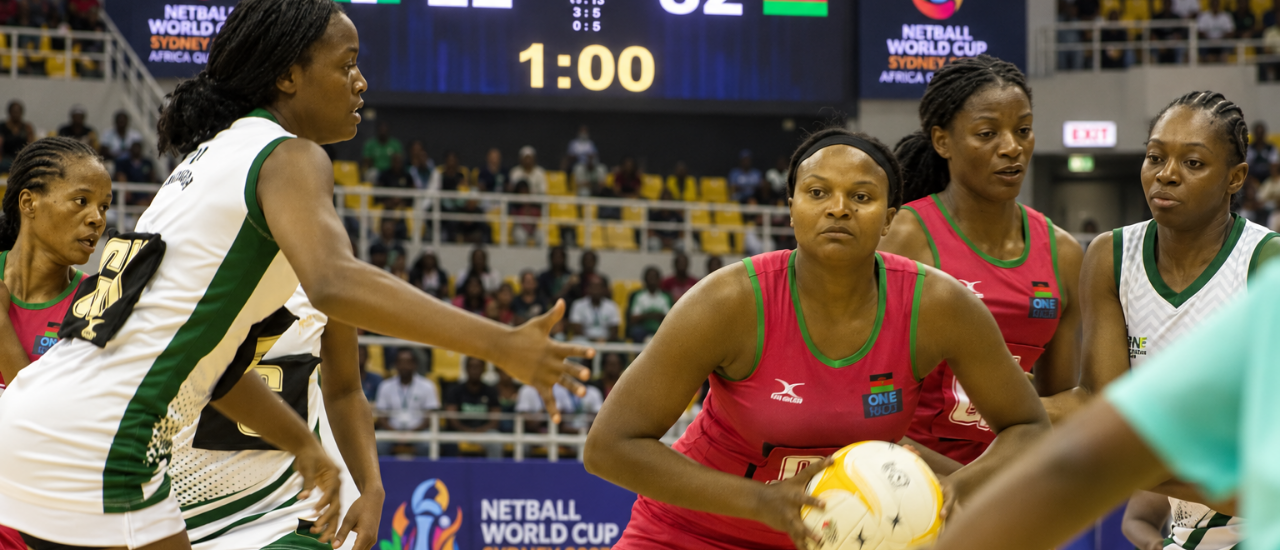
From school courts and Mary Waya to Mwawi Kumwenda, World Cup upsets and an 82–22 demolition of Nigeria, the Malawi Queens’ latest qualification is not a continuation of one of the most enduring traditions in Malawian sport.
Twice in 2026, Malawi met Nigeria in women’s sport.
The first time was in football.
Malawi’s Scorchers arrived at the Women’s Africa Cup of Nations as debutants. Their first-ever match at the continental finals was against Nigeria: the defending champions, the record 10-time winners, and a country that had never lost a WAFCON match to a tournament debutant. Malawi won 3–2.
The second meeting came less than two months later, in a completely different sport.
This time, Nigeria were the newcomers.
The Green Hawks had only just assembled Nigeria’s first senior national netball team and were making their first appearance at the Africa Netball Cup in Nairobi. By the time they met Malawi, they were only a few matches into their international life.
Waiting for them were the Malawi Queens.
The result was emphatic:
Nigeria 22. Malawi 82.
A 60-goal margin.
But the number only becomes truly interesting when you understand what sits behind it.
Nigeria’s coach Alison Rosemarie described the experience afterwards with striking candour: her team was “being schooled.” She spoke about Malawi’s elevation, speed and fast feet, and acknowledged that Nigeria were only at the beginning of their journey.
Malawi, on the other hand, has been on this journey for generations.
And that is the real story.
Before the Queens were global, netball was already Malawian
Netball did not arrive in Malawi yesterday.
Historical research into sport in colonial-era Nyasaland suggests the game was introduced into government girls’ schools in the late 1930s or early 1940s. Over time, it became an integral part of physical education and the principal extracurricular sport for girls in many schools.
That matters.
Elite national teams are rarely created at the moment they become internationally visible. They are produced much earlier, through repetition, familiarity, school systems, community participation and generations of young people growing up knowing that a particular sport belongs to them.
For many Malawian girls, that sport was netball.
Long before television audiences knew the Queens, long before Malawian players were appearing in elite leagues overseas, and long before World Cup rankings began placing Malawi alongside some of the richest sporting countries on earth, the game was already being passed from one generation to another.
That culture eventually produced one of the defining figures in Malawian sport.
Mary Waya and the first great era
Mary Waya began playing international-level netball for Malawi at just 14 years old.
She would eventually represent the country in more than 200 international matches, competing across World Championships, Commonwealth Games and other major international competitions.
Her career overlapped with Malawi’s emergence onto the global stage.
The Queens made their Netball World Cup debut in Birmingham in 1995 and immediately finished eighth in the world. Four years later, Malawi finished 11th in Christchurch.
Then came Auckland.
At the 2007 Netball World Cup, with Waya playing in her final World Cup, Malawi finished fifth in the world — the highest World Cup placing in the country’s history.
Fifth.
Not fifth in Africa.
Fifth in the world.
Australia, New Zealand, Jamaica and England finished ahead of Malawi. South Africa finished behind them.
That tournament established something that has now lasted for nearly two decades: Malawi was no longer merely an African netball nation capable of occasionally troubling stronger teams.
Malawi had become part of the global elite.
World Netball itself now describes Malawi as a fixture in the world’s top eight for two decades.
And the results support that description.
After fifth place in 2007, Malawi finished sixth in 2011, sixth again in 2015, remained among the leading nations through the 2019 cycle, and finished seventh at the 2023 World Cup in Cape Town.
This is not a one-tournament phenomenon.
It is institutional sporting memory.
Then came Mwawi Kumwenda
If Mary Waya represents the generation that helped establish Malawi globally, Mwawi Kumwenda represents the moment Malawian netball produced a genuine international superstar.
Her beginning sounds almost mythic now.
World Netball records that Kumwenda first played netball at 15 in her village. Later accounts describe her growing up playing barefoot on dirt, using improvised equipment before eventually reaching professional leagues overseas.
By 2015, she was not simply one of Malawi’s best players.
She was one of the best netball players in the world.
At the 2015 Netball World Cup in Sydney, Kumwenda scored 321 goals in eight matches, shooting at 91 percent, and was named Player of the Tournament. She was the only player at the tournament to score more than 300 goals.
Malawi themselves were the highest-scoring team at the tournament and finished sixth overall.
Three years later, at the 2018 Commonwealth Games, Malawi produced one of the most famous results in the country’s sporting history.
Malawi 57–53 New Zealand.
Kumwenda scored 41 goals.
New Zealand are not an emerging netball country. They are one of the foundational powers of the sport. Yet Malawi beat them on one of the biggest stages available.
That victory is useful context for anyone encountering the Queens for the first time in 2026.
Malawi beating Nigeria by 60 goals is dramatic.
But Malawi being excellent at netball is not new.
The numbers have always told their own story
The Queens have produced some extraordinary scorelines over the years.
At the 2015 World Cup, Malawi beat Sri Lanka 101–18 — an 83-goal margin and, at the time, a new Malawi record for points scored in a major tournament.
At the 2019 World Cup, they scored 87 against Singapore, winning 87–38.
At the 2023 World Cup, Malawi defeated Barbados 84–48.
And now:
2026 — Malawi 82–22 Nigeria.
So while a 60-goal victory understandably catches attention, it also belongs to a longer statistical pattern.
The Queens have spent years demonstrating that when the competitive gap between Malawi and an opponent is significant, they are capable of making that gap brutally visible on the scoreboard.
But they have also shown that they can stand in the ring with the world’s strongest teams.
That combination — dominance against developing programmes and genuine competitiveness against traditional powers — is why Malawi’s netball identity deserves to be understood differently from many of the country’s other sporting stories.
Nairobi: three games, three wins
The current road to Sydney began in Nairobi at the 2027 Netball World Cup Africa Qualifier, staged alongside the Africa Netball Cup.
Malawi opened against Zambia.
Malawi 72–38 Zambia.
A 34-goal victory.
Then came hosts Kenya.
This one demanded something different.
Malawi led 15–9 after the first quarter, but Kenya pushed back. At halftime the lead was only four, 28–24. The Queens steadied themselves in the third quarter and eventually won:
Malawi 55–47 Kenya.
Then came Nigeria.
The Queens were ahead 21–6 after the first quarter.
At halftime: 40–11.
After three quarters: 63–14.
Final score:
82–22.
Nigeria managed just three goals in the third quarter while Malawi scored 23.
Through their first three matches in Nairobi, Malawi scored 209 goals and conceded 107.
That is a cumulative goal difference of +102.
Three games.
Three wins.
And a ticket to Sydney.
Malawian and Nigerian reporting both confirmed that the Nigeria victory guaranteed Malawi’s place at the 2027 Netball World Cup, with South Africa and Uganda already qualified through world ranking and the structure of the remaining African qualification places making Malawi’s progression decisive.
The Queens still have work to do in Nairobi. Their final Pool 2 fixture comes against Uganda on September 23 before the competition progresses into its final stages.
But the central objective has already been achieved.
Malawi is going to Sydney.
Eighth in the world — and still rebuilding
As of World Netball’s rankings based on matches through September 1, 2026, Malawi sits eighth in the world.
Ahead of them are Australia, New Zealand, England, Jamaica, South Africa, Uganda and Tonga.
That ranking is simultaneously impressive and instructive.
The Queens are not currently at their historical peak. Malawi has previously sat higher in the global hierarchy and has gone through periods in which South Africa and Uganda have strengthened considerably.
But remaining inside the global top eight through generational transition is itself evidence of depth.
Players change.
Coaches change.
Administrations change.
Form rises and falls.
The institution survives.
That may ultimately be the most important lesson of the Queens.
A country of sporting women
There is another reason the Nigeria result feels particularly significant in 2026.
Malawi’s women are doing this across sports.
At WAFCON in July, the Scorchers entered the tournament having never played at the continental finals before. Nigeria entered as 10-time African champions and defending champions.
Before facing Malawi, Nigeria had played 17 WAFCON matches against tournament debutants.
Their record: 16 wins, one draw, zero defeats.
Then Malawi arrived.
Temwa Chawinga scored twice.
Tabitha Chawinga scored once.
Malawi 3–2 Nigeria.
The Scorchers went on to reach the final in their debut tournament and, by defeating Ghana in the quarter-final, secured Malawi’s first-ever FIFA Women’s World Cup qualification for Brazil 2027.
Now reverse the roles.
In netball, Nigeria are the debutants.
Malawi are the established power.
And the result is:
Nigeria 22–82 Malawi.
Two national teams.
Two sports.
Two debutant stories.
Two World Cup tickets.
One year.
There is something bigger happening here than a pair of scorelines.
What it takes to build a team like this
An 82–22 win is completed in 60 minutes.
It takes decades to build the team capable of producing it.
It takes girls encountering netball in schools.
It takes local coaches.
It takes domestic clubs.
It takes women playing when there is little money, little infrastructure and little international attention.
It takes one generation becoming visible enough that the next can imagine something larger.
Mary Waya helped establish what a Malawian netballer could become.
Mwawi Kumwenda expanded the possibility.
So did Joyce Mvula, whose career took her into elite professional netball abroad.
So did the generations of Queens who kept Malawi inside the world’s top tier when resources available to them were rarely comparable to those enjoyed by the countries surrounding them in the rankings.
This is how sporting traditions are built.
Not through a single tournament.
Through accumulation.
A court.
A school.
A coach.
A player.
A national team.
A fifth-place finish.
A professional contract abroad.
A victory against New Zealand.
A girl watching.
And then another generation.
Sydney is not the beginning
When the Queens arrive in Australia for the 2027 Netball World Cup, they will be returning to a city already embedded in Malawi’s netball history.
Sydney hosted the 2015 World Cup — the tournament where Malawi finished sixth, finished as the competition’s highest-scoring team, and watched Mwawi Kumwenda leave as Player of the Tournament.
Twelve years later, Malawi will return.
Different generation.
Same name on the bib.
Same flag.
Same inheritance.
That is why the road to Sydney should not be told simply as the story of a team that beat Nigeria 82–22.
That result is the latest chapter in a sporting tradition that began long before most of its current players were born.
From school courts in colonial-era Malawi.
To Mary Waya.
To fifth in the world.
To Mwawi Kumwenda.
To 101–18.
To 57–53 against New Zealand.
To generations of Queens who kept Malawi among the world’s strongest netball countries.
And now, to Nairobi:
72–38.
55–47.
82–22.
Sydney awaits.
And from all of us at Kwathu Kollective: congratulations to the Malawi Queens on securing another World Cup journey.
The ticket has been punched.
Now go and remind the world who Malawi is. 🇲🇼❤️🔥
Work With Us
Want to partner on or fund one of our programmes / initiatives? We are always open to collaborations and partnerships. Contact us via kollective@kwathu.org.
To keep up with the work of the Kwathu Kollective, our initiatives and our projects, follow us on socia media:
KWATHU KOLLECTIVE SOCIAL MEDIA


