
Kwathu Kollective in Bellagio
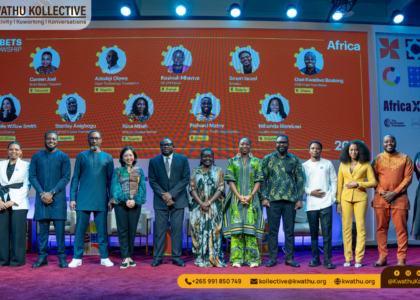
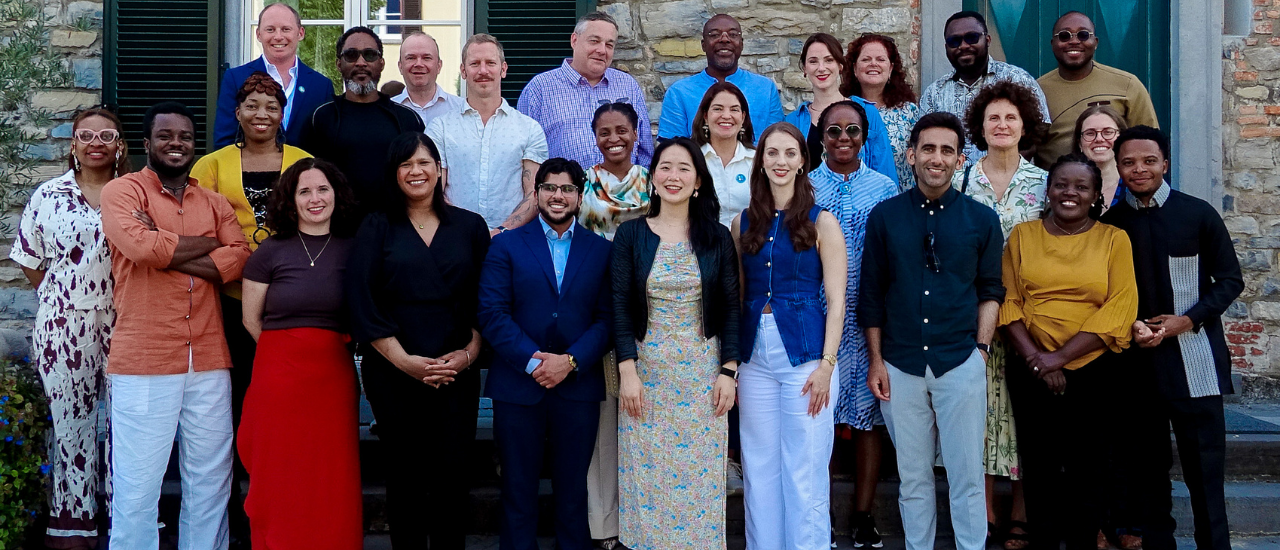
Kwathu Kollective Founder and Managing Director, Nthanda Manduwi, recently completed the Rockefeller Foundation Big Bets Fellowship residency at the Bellagio Center in Lake Como, Italy, as part of the inaugural 2026 Africa cohort.
From 24–28 August 2026, Nthanda joined fellows from across Africa and the United States at the Rockefeller Foundation Bellagio Center for an intensive week focused on strengthening ambitious ideas, pressure-testing strategies, building partnerships and translating bold visions into actionable systems.
The Bellagio gathering marked the culmination of several months of work under the Rockefeller Foundation Big Bets Fellowship, a five-month leadership programme designed for leaders working on ambitious solutions to complex social and economic challenges.
For Kwathu Kollective, the residency came at an important point in the evolution of our work.
From Digital Access to Productive Capacity
For several years, Kwathu Kollective and the Ntha Foundation have worked at the intersection of education, technology, entrepreneurship and youth development.
Our work began with a simple question: what happens when young Africans gain access to tools, knowledge and opportunities they might otherwise never encounter?
That question led to digital-skills programmes, technology hubs, entrepreneurship fellowships, apprenticeship programmes, game development, IoT, agricultural technology, simulation and, increasingly, robotics and cyber-physical systems.
Over time, however, the question has become more demanding.
Access alone is not enough.
Training alone is not enough.
Formal education alone is not enough.
The challenge is increasingly about how knowledge becomes competence, how competence becomes productive work, and how productive work becomes part of stronger firms, industries and institutions.
This was one of the central ideas that crystallised further during the Bellagio residency.
Building People Who Can Build Systems
During the week, fellows were deliberately encouraged to expand their thinking before narrowing it back into strategy.
The Bellagio programme moved through scenario planning, strategic futuring, theory-of-change pressure testing, partnership design, peer learning and storytelling. Fellows were challenged to ask what was central to their work, what assumptions might no longer hold, what capabilities they did not yet possess and what partnerships would be required to move from ambitious ideas into durable systems.
For Kwathu, this process helped connect several programmes and ventures that had previously developed along parallel tracks.
At the centre is a growing human-capital proposition.
Nyenyezi, our entrepreneurship pathway, focuses on building people who can recognise opportunities and create new ventures, products and systems.
M’mawa, our apprenticeship pathway, focuses on developing people who can enter organisations and competently operate, improve and manage existing systems.
The two programmes have different functions, but increasingly point towards the same destination: productive competence.
One of the ideas now being explored is how these pathways could evolve into a one-year, university-partnered, degree-conferring model combining formal academic learning with simulation, applied work and paid industry placements.
The proposition remains under development, but the direction is becoming clearer: young people should not leave education only knowing more. They should leave increasingly capable of building and operating the systems around them.
Where Agriculture, Engineering and Simulation Meet
Agriculture remains one of the most important application areas for this thinking.
Kwathu Smart Innovation Farms [KSIF] is being developed as a space where agriculture can meet computer science, engineering, business and systems thinking.
The long-term model connects physical agricultural environments with sensors, data, digital models, simulation and emerging autonomous technologies.
The principle behind this work is simple:
You cannot be what you cannot see.
We are increasingly extending that idea further:
You cannot build what you cannot see.
Simulation and experiential learning can help young people interact with systems they may not otherwise have immediate access to, from advanced farms and industrial operations to robotics, logistics and other cyber-physical environments.
The goal is not to replace physical experience with digital learning. It is to connect the two.
A learner should be able to understand a system, experiment with it, observe consequences and eventually work within the real environment with stronger mental models.
Following the Value Chain Further
Another important outcome from Bellagio was thinking more deliberately about what happens beyond primary production.
A farm cannot end at the farm gate.
If African economies are to create greater value from what they already produce, young people need exposure not only to cultivation, but also to processing, manufacturing, formulation, packaging, branding, distribution and markets.
This is where other Kwathu-linked ventures such as Moyo Botanicals and Effortless Natural begin to take on a wider role within the learning architecture.
They can become practical environments for understanding how raw materials move through a value chain and how businesses create additional economic value at each stage.
The broader ambition is to create learning environments in which young people can encounter the entire journey from knowledge to production, and from production to market.
The Work Ahead
The Bellagio residency did not produce a finished model.
Several important questions remain open.
The proposed degree architecture still requires university partners.
The industry placement model needs to be tested with employers.
Some of the robotics and autonomous-systems work remains at prototype and research stage.
The commercial models around simulation and physical production must demonstrate that they can generate sustainable revenue.
Those are exactly the kinds of questions we intend to spend the next phase answering.
What became clearer at Bellagio is that Kwathu’s work is increasingly converging around one central ambition:
Building competent people. Building productive systems. Creating value.
Our focus remains rooted in Malawi, but the challenge is much larger than one country.
Africa has one of the youngest populations in the world and an extraordinary amount of talent. The next question is how that talent becomes productive capacity capable of building farms, companies, technologies, industries and institutions that can compete and create value at scale.
That is the work we are returning to after Bellagio.
And there is a great deal more to build.
Work With Us
Want to partner on or fund one of our programmes / initiatives? We are always open to collaborations and partnerships. Contact us via kollective@kwathu.org.
To keep up with the work of the Kwathu Kollective, our initiatives and our projects, follow us on socia media:
KWATHU KOLLECTIVE SOCIAL MEDIA